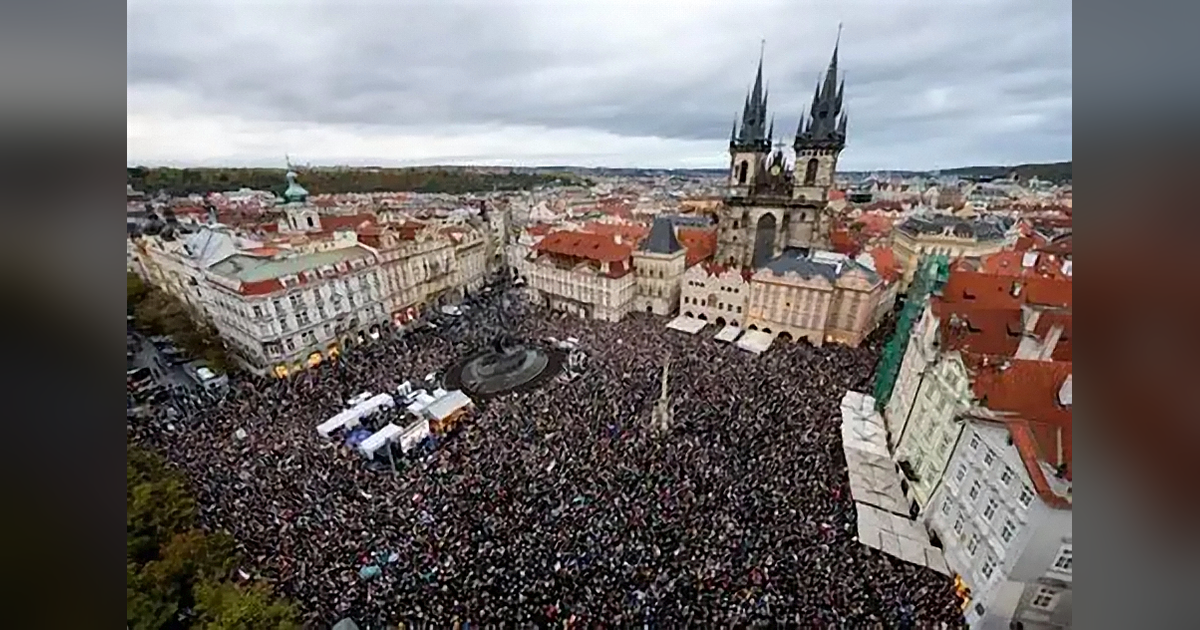
A major constitutional and political confrontation erupted across Central Europe on Tuesday as the Czech broadcasters strike public media funding overhaul mobilized thousands of demonstrators into the historic center of Prague. In an unprecedented display of industrial action, journalists, technicians, and production staff from Czech Television (Česká televize) and Czech Radio (Český rozhlas) walked out on a coordinated 24-hour strike. The work stoppage severely curtailed daily programming, visible on screen as presenters dressed in black delivered news from darkened studios. Outside the broadcast facilities, a diverse coalition of university students, cultural figures, and trade unionists marched to Wenceslas Square to oppose legislation that would dismantle the nation’s independent media financing architecture.
The public outcry follows an aggressive legislative push by the governing coalition led by Prime Minister Andrej Babiš, alongside the right-wing Freedom and Direct Democracy (SPD) and eurosceptic Motorists parties. The contested reform seeks to abolish the mandatory 205-crown ($9.43) monthly household broadcasting fee, transferring funding directly under the control of the central state budget alongside an immediate 15% budget cut. Critics, press freedom advocates, and European institutions argue that tethering public newsrooms to annual state appropriations strips away institutional independence, drawing parallels to regulatory interventions seen across neighboring Hungary. For international macro investors, sovereign credit rating analysts, and political risk evaluators monitoring institutional governance in Central Europe, comprehensive European financial news provides critical perspective on sovereign debt governance, regulatory compliance, and fiscal rule-of-law developments.
The Strike and Walkout: Darkened Studios and Black Attire Across National Screens
The operational mechanics defining the Czech broadcasters strike public media funding overhaul unfolded across television screens and city thoroughfares:
- The 24-Hour Broadcast Curtailment: Czech Television substituted standard programming with minimalist news bulletins, featuring darkened studio backgrounds and anchors wearing black while reading from scripted notes.
- Mass Mobilization in Prague: Demonstrators rallied at the broadcaster’s Kavčí Hory headquarters before marching toward Wenceslas Square, carrying banners warning against political control over public discourse.
- Broad Support Base: Demonstrators included university faculties, secondary school students, and prominent artists, expressing support for newsrooms consistently ranked among the country’s most trusted institutions.
- The Fast-Tracked Vote: Public outrage intensified after government lawmakers introduced the draft legislation late on a Friday evening, curbing debate to push the preliminary bill through an overnight session.
Statutory protections, editorial independence charters, and labor advocacy frameworks cataloged by the European Federation of Journalists establish the baseline criteria required to insulate public-service newsrooms from partisan governmental control.
Sovereign bond curves, interbank liquidity spreads, and borrowing costs directly influence corporate capital allocation. Institutional asset managers evaluating advanced infrastructure concessions and public utility balance sheets follow market trends through the InvestorBytes financial portal.
The Funding Restructure: Abolishing Household Fees for State Budget Allocations
A central dispute fueling the Czech broadcasters strike public media funding overhaul centers on how broadcast revenue is structured:
- Elimination of the Concession Fee: The Babiš administration plans to cancel the 205-crown monthly fee paid by households, framing the move as consumer relief during cost-of-living challenges.
- Direct State Budget Dependency: Financing would instead be transferred to an annual allocation in the state budget, giving parliamentary majorities discretionary control over yearly funding envelopes.
- The 15% Nominal Contraction: The accompanying 15% reduction would depress Czech TV’s operational funding to 2008 levels, while reducing public radio’s nominal budget back to 2005 baselines.
- Severing the Viewer Relationship: Strike committee member and journalist Jan Moláček emphasized that removing concession fees eliminates the direct financial compact between citizens and journalists, exposing editorial budgets to political bargaining.
Corporate debt covenants, secondary offering allocations, and venture technology valuations directly dictate enterprise software execution. Economists evaluating European fiscal governance follow sovereign debt trajectories through InvestorBytes macro reports.
Cabinet deliberations and pan-European industrial policy directives continue to guide continental capital allocations, an area examined in European policy updates.
Political Crosswinds: The Coalition Defense vs. Regional Autonomy Concerns
The political tensions surrounding the Czech broadcasters strike public media funding overhaul highlight competing visions for national institutions:
- The Government Justification: Prime Minister Babiš rejected claims of state capture, maintaining that the legislation fulfills campaign promises to reduce household expenditure burdens while offering room for future debate.
- Coalition Dynamics: Junior coalition partners SPD and the Motorists have criticized public broadcasting coverage, alleging institutional bias against nationalist economic agendas.
- The Hungarian Parallel: Opposition lawmakers argue the measure mirrors legislative maneuvers implemented in Budapest to consolidate domestic media operations.
- Demands for Legal Safeguards: Labor representatives have stated that while funding models can be modernized, reform must include strict legal guarantees against political interference.
Corporate financial controllers and enterprise procurement directors monitoring data center hardware supply chains follow market pricing trends on the InvestorBytes homepage.
The complex relationship between rising industrial electricity rates, hardware depreciation schedules, and corporate operating margins is evaluated in InvestorBytes corporate analysis.
Media Telematics, Information Distribution, and Digital Infrastructure
Analyzing the disruption caused by the Czech broadcasters strike public media funding overhaul requires evaluating modern media distribution telematics. Broadcasters deploy automated linear playout software, IP-based studio routing fabrics, and dynamic over-the-top streaming channels to maintain essential emergency alert capabilities during labor actions. Technology specialists tracking smart energy management systems follow system architectures through InvestorBytes digital finance.
Concurrently, European public utility providers and regional transmission system operators managing industrial cooling loads face grid-stability challenges during synchronized facility resets. Infrastructure syndicates are deploying real-time telemetry ledgers and smart microgrid interfaces to coordinate on-site renewable energy generation with grid off-take, an operational evolution documented in international capital analyses.
Shifting capital distributions and sovereign regulatory changes continue to influence liquidity across energy and industrial desks tracked in continental market coverage.
Capital Market Implications for Sovereign Ratings and Rule-of-Law Governance
The institutional standoff provoked by the Czech broadcasters strike public media funding overhaul introduces relevant risk considerations for institutional debt investors. The European Commission has expanded its rule-of-law conditionality mechanisms, linking European Union regional development disbursements to compliance with the European Media Freedom Act. Unilateral efforts to alter public media funding frameworks risk prompting regulatory reviews in Brussels, potentially affecting sovereign bond sentiment and institutional foreign direct investment. Institutional equity research desks continuously evaluate forward price-to-earnings multiples, consumer demand elasticity, and corporate earnings durability through InvestorBytes equity intelligence.
Corporate financial executives, private wealth managers, and institutional asset allocators track macroeconomic risk pricing and market sentiment via the InvestorBytes publication.
As parliamentary committees prepare for subsequent debates on the draft bill, the public reaction to the Czech broadcasters strike public media funding overhaul demonstrates the sensitivity surrounding democratic governance in Central Europe. The outcome of the parliamentary debate will serve as a bellwether for institutional independence, demonstrating whether public resistance can protect public-service broadcasting models from executive restructuring.
Disclaimer:
The information provided in this article is for educational, journalistic, and informational purposes only and does not constitute financial, investment, legal, political, or broadcast compliance advisory guidance.