A decisive philosophical debate is confronting continental policymakers as the founder of one of the bloc’s prominent deep-tech unicorns argued that European AI optimism must supersede regulatory anxiety if the continent is to avoid structural irrelevance. Robin Rombach, chief executive officer of German image-synthesis pioneer Black Forest Labs, delivered a sharp critique of Brussels’ risk-averse stance, warning that prioritizing fear over opportunity will permanently entrench dependency on American and Chinese computational architectures. Speaking in an interview with Agence France-Presse (AFP), Rombach emphasized that while international safety discussions intensify, excessive caution risks paralyzing European founders during a critical phase of global compute scaling.
The debate over continental digital posture carries substantial implications for industrial productivity, venture capital flows, and sovereign technological autonomy. When early-stage technology ecosystems operate under restrictive compliance frameworks while simultaneously lacking specialized risk capital, foundational model developers frequently relocate intellectual property overseas. For corporate technology directors, institutional software investors, and research engineers evaluating how regulatory mandates shape artificial intelligence commercialization, comprehensive reporting across tech provides vital clarity on computational transformation.
Escaping the Precautionary Trap: Opportunity Versus Regulatory Hesitation
The central premise driving the call for European AI optimism is the growing technological gap separating European labs from foreign competitors. While Silicon Valley powerhouses such as OpenAI and Anthropic, alongside Chinese innovators like DeepSeek, deploy massive compute clusters, European enterprises remain constrained by administrative oversight and fragmented capital markets.
“I think the mindset in Europe needs to shift to one of optimism and to one of opportunity, and not to one of risk and fear,” Rombach asserted. A co-developer of latent diffusionn the foundational mathematical architecture underpinning contemporary text-to-image synthesis Rombach established Black Forest Labs in 2024 alongside fellow researchers in the German city of Freiburg. The startup, valued at approximately $3.25 billion, develops the FLUX model family, which creates photorealistic still and moving visuals from textual prompts, and is now expanding into embodied physical robotics.
Despite its regional roots, the company maintains dual headquarters in San Francisco and secured foundational seed financing from American venture capital firm Andreessen Horowitz, illustrating how European deep-tech founders continue to rely on overseas capital.
Industrial deployment of advanced foundation models directly alters manufacturing automation, design throughput, and long-term gross domestic output. Economists analyzing how technological adoption and digital infrastructure spending reshape aggregate economic competitiveness can follow structural indicators through dedicated coverage of the broader economy.
The Capital Bottleneck: Venture Funding Versus Conservative Banking
Fostering authentic European AI optimism requires resolving the continent’s venture capital funding shortfall. Zach Meyers, digital policy expert at the Brussels-based Centre on Regulation in Europe (CERRE), noted that the primary obstacle to European artificial intelligence expansion is not a lack of engineering talent, but access to risk-tolerant capital pools.
European commercial enterprises remain reliant on traditional commercial bank lending, a financing structure poorly aligned with deep-tech research requiring massive upfront capital expenditure before generating revenue. “That is not how technology markets work, particularly with a really nascent technology like AI,” Meyers explained.
Comparative Realities Facing European Deep-Tech Ecosystems
The operational bottlenecks confronting domestic artificial intelligence developers reflect systemic disparities:
- Capital Velocity: While US and Chinese labs secure multi-billion-dollar private rounds within weeks, European founders must navigate conservative European investment committees and public grant mechanisms.
- Compute Infrastructure: Access to high-end graphics processing units (GPUs) remains heavily concentrated in North America, forcing European researchers to lease foreign data center capacity.
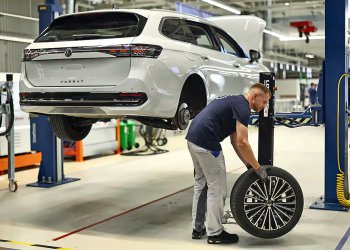
- Industrial Integration: In contrast to software-only applications, Black Forest Labs has piloted physical AI models with German automaker Audi to automate production-line robotic tasks.
- Cultural Pushback: The startup recently faced scrutiny from creative unions after naming American film director Martin Scorsese as a creative advisor, reflecting labor anxieties regarding creative displacement.
Sovereign technology mandates, the European Union’s AI Act, and digital copyright directives remain central topics across European administrative capitals. Observers tracking how executive decrees and parliamentary committees regulate algorithm deployment can follow legislative developments via politics.
Open-Weight Architectures, Transparency, and Human Error
A key defense supporting European AI optimism lies in Black Forest Labs’ commitment to “open-weight” foundation models. Unlike closed proprietary systems, open-weight architectures permit researchers and enterprise developers to download parameters locally, conduct transparent safety audits, and inspect model behavior.
Rombach argued that open deployment increases baseline safety by preventing compute monopolies from centralizing control over transformative infrastructure: “The main thing that can wipe out humanity is stupidity,” he observed, arguing that human judgment errors pose a greater immediate risk than runaway algorithmic sentience.
Deploying open architectures across enterprise environments requires robust operational software. Machine learning engineers utilize distributed inference pipelines, containerized microservices, and specialized edge computing to optimize local model performance.
At the same time, international software consortia distributing open-source algorithmic weights across global developer networks are exploring decentralized infrastructure. Engineering collectives evaluate programmatic settlement protocols, decentralized compute marketplaces, and crypto networks to settle high-frequency micro-payments for peer-to-peer compute capacity without clearing friction.
Liquidity distribution across generative computing platforms continues to shape valuation multiples across global financial markets.
Enterprise Balance Sheets and Listed Technology Equities
The broader commercialization of European AI optimism establishes crucial benchmarks for institutional allocators. While specialized European artificial intelligence labs like Black Forest Labs and France’s Mistral demonstrate technical competence, institutional portfolio managers evaluate how public cloud providers, enterprise software vendors, and semiconductor designers monetize model integration. Analysts continuously track corporate margins and research expenditures across publicly traded stocks.
According to formal enterprise policy briefs published by the Centre on Regulation in Europe (CERRE), establishing competitive single-market financial frameworks is essential to prevent European technology firms from being acquired by overseas conglomerates.
Institutional asset allocators and corporate directors also assess balance-sheet health and digital asset financing across broader business & finance channels.
As safety debates continue in Brussels, the call for European AI optimism highlights a critical choice for continental leadership. If Europe continues to treat generative software as a liability rather than a generational economic opportunity, its industrial base will rely on imported foreign software. Embracing risk, funding deep tech, and supporting domestic developers will decide whether Europe shapes the next computing era or merely regulates it.
Disclaimer:
The information provided in this article is for educational, journalistic, and informational purposes only and does not constitute financial, investment, software procurement, or legal advice.