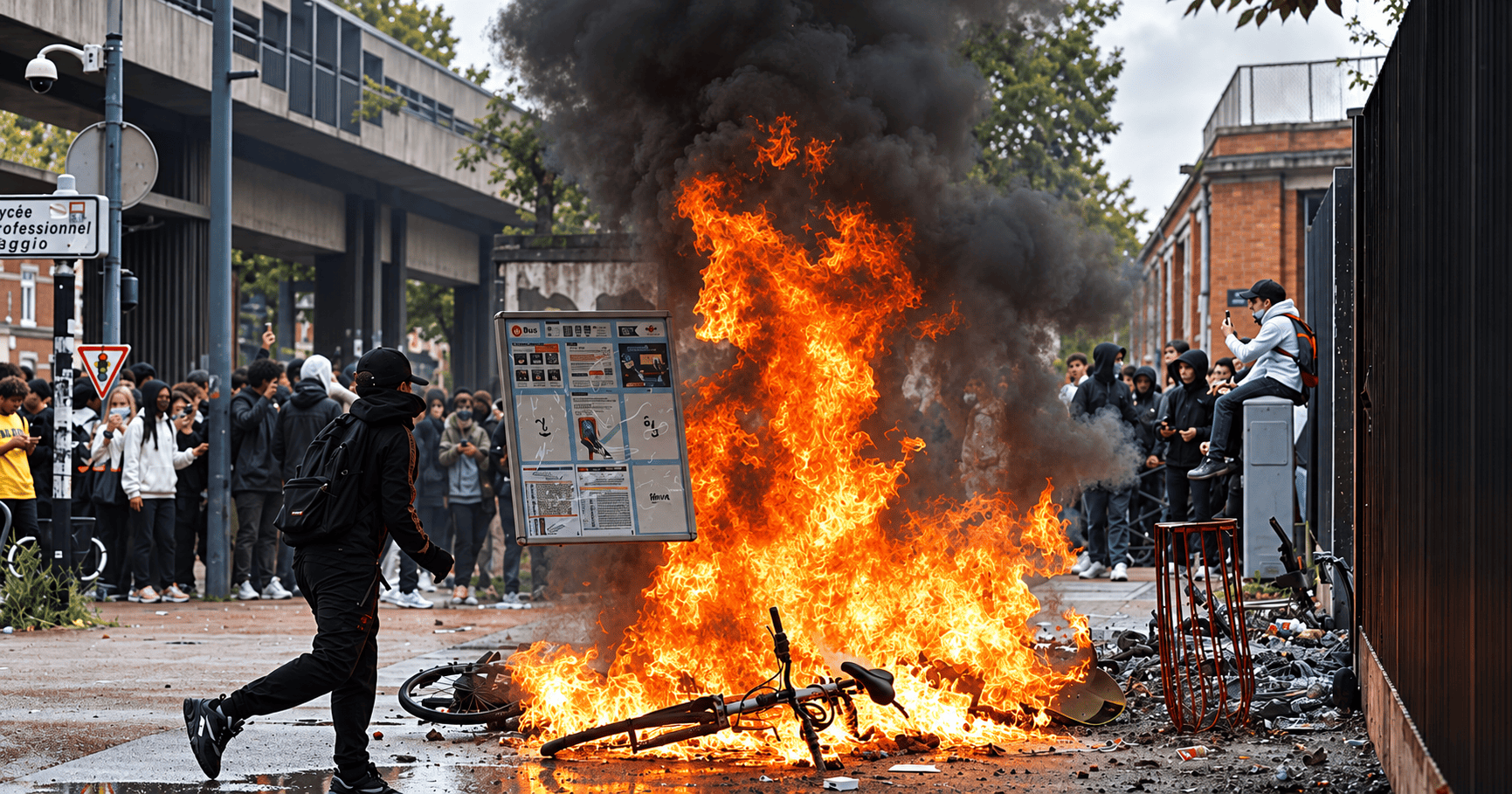
A nationwide civic emergency erupted across the French Republic on Friday as violent France school protests clashes between motorized riot police and demonstrating high school students forced the closure of more than 400 secondary schools. From the eastern boulevards of Strasbourg to the Mediterranean avenues of Marseille, industrial port centers in Rennes, and the banlieues of Paris, security forces deployed tear gas, batons, and kinetic dispersal projectiles against teenage demonstrators blockading educational campuses. The escalating unrest ignited by systemic classroom overcrowding, critical shortages of substitute teachers, and dilapidated municipal infrastructure has quickly morphed into a major political crisis for President Emmanuel Macron’s administration just six months before upcoming presidential elections.
The rapid escalation of youth demonstrations into coordinated urban blockades illustrates the profound societal friction generated by statutory austerity measures across Western Europe. With public administrations attempting to enforce fiscal discipline to stabilize sovereign credit ratings, reductions in domestic public services are provoking intense civil pushback. When riot police deploy chemical munitions against secondary pupils demanding basic educational resources, the crisis transcends municipal policing to threaten executive governance. For public policy researchers, constitutional law scholars, and political risk consultants evaluating how social unrest reshapes electoral mandates, comprehensive newsroom reporting on politics provides essential intelligence on European institutional governance.
Nationwide Disruption: Tear Gas, Barricades, and 2,000 Detentions
The physical intensity characterizing the France school protests clashes reflects a significant hardening of protest tactics across major metropolitan areas. Outside the Lycée Déodat-de-Séverac in Toulouse, students constructed barricades out of overturned rubbish bins and ignited defensive fires to prevent security units from dismantling their campus blockade. In the southern port city of Marseille, commercial pyrotechnic rockets were directed at advancing gendarme cordons, while students in central Paris brandished placards proclaiming: “We have a future to build, not to endure.”
The institutional response from the French Ministry of the Interior has been unyielding:
- Mass Arrests: Justice Minister Gérald Darmanin confirmed on RTL radio that security forces have detained more than 2,000 individuals the vast majority minors since the demonstrations erupted in the Île-de-France region.
- Financial Penalties for Families: Darmanin insisted that the legal guardians of juvenile protesters detained for municipal property damage should be held financially liable for civil reparations.
- Campus Closures: Education Minister Édouard Geffray reported that approximately 400 lycées representing roughly one in every ten high schools in France were shuttered to prevent further campus occupations.
- Cross-Border Contagion: Highlighting regional resonance, student demonstrations crossed sovereign borders on Thursday, prompting high school blockades and precautionary closures in the Belgian city of Liège.
Widespread school closures, disrupted commuter corridors, and municipal damage directly disrupt retail commerce, urban workforce attendance, and public transport throughput. Economists tracking how prolonged urban unrest and structural fiscal compression impact commercial output follow long-term trends through dedicated coverage of the broader economy.
Fiscal Roots: Debt Servicing Surpasses the Education Budget
The structural catalyst fueling the France school protests clashes stems directly from the government’s 2027 draft budget bill presented to the Council of Ministers. Under the statutory proposal, nominal education funding will rise by a below-inflation 1.7% to €65.53 billion, excluding teacher pension liabilities.
For decades, the national education budget stood as the single largest expenditure line within the French state ledger. However, that historical hierarchy has been upended by soaring global borrowing costs. In 2027, the state’s sovereign debt servicing charges are projected to reach €74.5 billion, eclipsing the entire operational budget of the school system.
Opposition lawmakers from the hard-left France Unbowed (LFI) party have rejected government claims that their parliamentary deputies initiated the campus blockades, accusing the Élysée Palace of utilizing aggressive policing to silence legitimate public outcry over state disinvestment.
Corporate treasurers, municipal bond underwriters, and public finance specialists evaluate sovereign balance-sheet sustainability, public deficit management, and corporate liability exposure across broader business & finance channels.
Public Safety Systems, Video Telematics, and Digital Rails
Managing the escalating unrest driving France school protests clashes has pushed French law enforcement to rely heavily on modern urban surveillance technology. Municipal police command centers are deploying drone video telematics, algorithmic crowd density analytics, and geo-spatial tracking software to anticipate school barricades before pickets formalize. Technology professionals and systems engineers monitoring urban security platforms, encrypted telecom applications, and algorithmic monitoring follow developments via tech.
Concurrently, independent student unions, civic rights groups, and international humanitarian monitors providing legal assistance to detained minors face administrative hurdles with traditional banking channels during weekend court recesses. Forward-looking human rights defense networks and community bail collectives are evaluating programmable liquidity systems and crypto networks to execute transparent, instant bail micro-disbursements and legal defense remittances, bypassing commercial banking delays.
Prolonged civil unrest and rising sovereign risk premiums continue to influence investor sentiment and bond yield spreads across European financial markets.
Equity Realities for Publicly Listed Equities
The social destabilization highlighted by the France school protests clashes creates tangible risks for institutional equity allocators. Widespread disruptions across transit networks, combined with the risk of secondary solidarity strikes by transit unions, threaten quarterly retail foot traffic and commercial services revenue. Institutional equity research desks continuously evaluate retail consumer exposure, municipal concession risks, and public-sector contract exposure across publicly traded French stocks.
According to formal monitoring reports published by the human rights advocacy organization Amnesty International, state security personnel must observe strict proportionality, declaring that students exercising fundamental assembly rights must be protected from indiscriminate baton charges and kinetic projectile strikes.
As French education officials struggle to reopen locked classrooms, the France school protests clashes underscore a defining societal dilemma. When sovereign debt interest payments surpass national education spending, the financial strain lands directly in the classroom sparking a generational confrontation that the French government cannot easily resolve with riot police alone.
Disclaimer:
The information provided in this article is for educational, journalistic, and informational purposes only and does not constitute political, legal, civic policing, or investment advice.