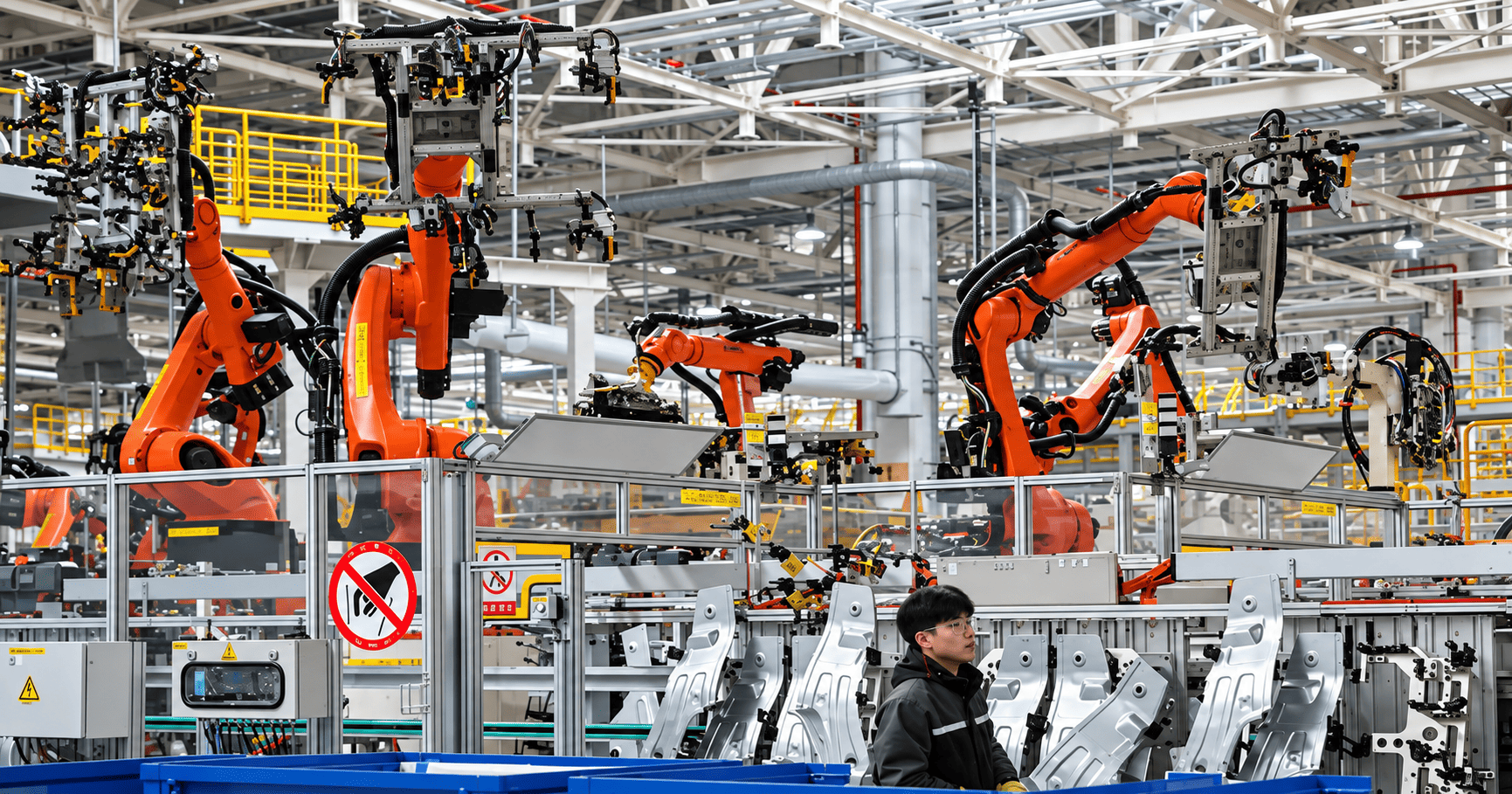
A powerful divergence between capital goods investment and consumer retrenchment has emerged across international industrial hubs, as a global factory activity AI boom powered manufacturing indexes across Europe and Asia to multi-year highs. Preliminary purchasing managers’ index (PMI) data published on Thursday demonstrated that accelerating global demand for artificial intelligence hardware, advanced semiconductor equipment, and high-specification robotics cushioned industrial producers against severe exogenous headwinds. Despite elevated energy price spikes triggered by ongoing conflict in the Middle East and renewed interest rate hikes by Western central banks, manufacturing capacity across leading export economies demonstrated unexpected operational resilience.
The industrial rebound highlights how transformative infrastructure spending can temporarily counteract standard macroeconomic cycles. While higher sovereign borrowing costs and persistent headline inflation continue to strain consumer purchasing power, enterprise capital expenditure directed toward foundational digital infrastructure has provided a critical floor for heavy industry. For institutional asset allocators, industrial treasurers, and sovereign risk analysts tracking how cyclical industrial metrics intersect with national growth trajectories, comprehensive newsroom reporting on the wider economy provides essential intelligence on global macro trends.
Eurozone Manufacturing: Netherlands and Germany Lead Expansion
The primary development driving the global factory activity AI boom within developed markets was a noticeable rebound across continental Europe. S&P Global’s Eurozone Manufacturing PMI climbed to 52.9 in September from 52.7 in August, reaching its strongest reading since May 2022 and remaining well above the 50.0 threshold separating operational expansion from contraction.
Factory output growth proved broad-based across the single-currency bloc, though structural divergence between capital goods and consumer goods remained pronounced:
- Regional Leaders: The Netherlands recorded the fastest manufacturing expansion across the European Union, buoyed by strong order books for advanced lithography and semiconductor fabrication equipment, while Germany the continent’s largest manufacturing powerhouse logged solid industrial gains.
- Peripheral Stabilization: Factory production expanded at a more measured pace across France, Italy, and Spain, where local manufacturers face higher sensitivity to domestic consumer demand.
- Capital Goods Concentration: Iain Simmons, senior economist at Oxford Economics, noted that factory strength was heavily concentrated in advanced capital goods, specialized computing components, and sovereign defense hardware, whereas consumer goods output contracted under sticky price inflation.
- Cost Headwinds: Accelerating raw material overheads and higher selling-price expectations are expected to weigh on industrial margins, creating an uneven production profile across the remainder of the year.
The capacity of European manufacturers to absorb input price shocks directly alters corporate liquidity requirements, working capital lines, and commercial banking exposures. Readers tracking corporate balance sheets, treasury management, and industrial solvency can evaluate in-depth assessments through business & finance reporting.
Asian Powerhouses: Semiconductor Surges in South Korea and Taiwan
The momentum behind the global factory activity AI boom was even more striking across the Asia-Pacific export corridor. Asian manufacturing exporters leveraged their dominant position in foundational electronics, specialized packaging, and memory hardware to capture expanding international orders.
In Taiwan, a central hub for cutting-edge semiconductor fabrication, the S&P Global Manufacturing PMI surged to 56.7 in September from 54.7 in August. Simultaneously, South Korea’s industrial sector expanded at its fastest pace in four months, driven by an export surge unmatched in more than a decade and a half.
“Both new orders and production growth hit the highest for around five-and-a-half years, with anecdotal evidence often linking the expansions to the combined strength of the semiconductor and automotive sectors,” noted Usamah Bhatti, economist at S&P Global Market Intelligence.
Conversely, Japan presented a more cautious picture, with its manufacturing PMI slipping to a six-month low as domestic output moderated, even as export orders rose for a ninth consecutive month. Across other regional hubs, India expanded at its fastest pace in seven months, while factory activity in Vietnam and Indonesia advanced against contractions in Malaysia and the Philippines.
Central bank monetary policy, export credit subsidies, and international trade protectionism remain primary concerns across government cabinets. Analysts tracking how statutory trade regulations and state industrial directives alter international trade follow updates via politics.
High-Performance Computing, Factory Telematics, and Supply-Chain Rails
The structural foundation enabling the global factory activity AI boom relies on advanced engineering and enterprise automation. Modern fabrication lines deploy algorithmic process controls, edge-based computer vision for automated quality inspection, and digital-twin plant modeling to maximize wafer yields and assembly-line throughput. Technology professionals and systems engineers monitoring automated fabrication hardware and industrial cloud infrastructure follow breakthroughs through specialized reporting on tech.
At the same time, multinational electronics consortiums and raw material suppliers managing multi-currency component procurement face significant foreign exchange volatility. Forward-looking corporate procurement treasuries are increasingly exploring programmable liquidity protocols and tokenized settlement systems on crypto networks to execute transparent, escrow-verified cross-border payments for critical silicon wafers without standard commercial banking delays.
Manufacturing order-book strength and shifting supply-chain bottlenecks continue to shape investor risk appetite across global commodity and currency markets.
Equity Realities for Publicly Listed Industrial and Tech Equities
The corporate beneficiaries of the global factory activity AI boom have established crucial benchmarks for equity portfolio allocators. While consumer-facing manufacturers struggle with volume contraction and higher borrowing costs, specialized equipment makers, foundry operators, and advanced robotics suppliers are sustaining solid pricing power. Institutional equity analysts evaluate these order backlogs, book-to-bill ratios, and operating margins across publicly traded industrial and semiconductor stocks.
According to formal market tracking from S&P Global, sustained expansion in global manufacturing output remains heavily dependent on continued corporate capital allocations toward generative compute clusters and next-generation power infrastructure.
As industrial surveys across Europe and Asia confirm, the global factory activity AI boom has temporarily shielded global manufacturing from a broader cyclical downturn. However, with central banks raising rates to tame energy-driven inflation, manufacturers must balance record capital goods backlogs against the threat of broader consumer demand erosion.
Disclaimer:
The information provided in this article is for educational, journalistic, and informational purposes only and does not constitute financial, investment, manufacturing procurement, or macroeconomic advice.