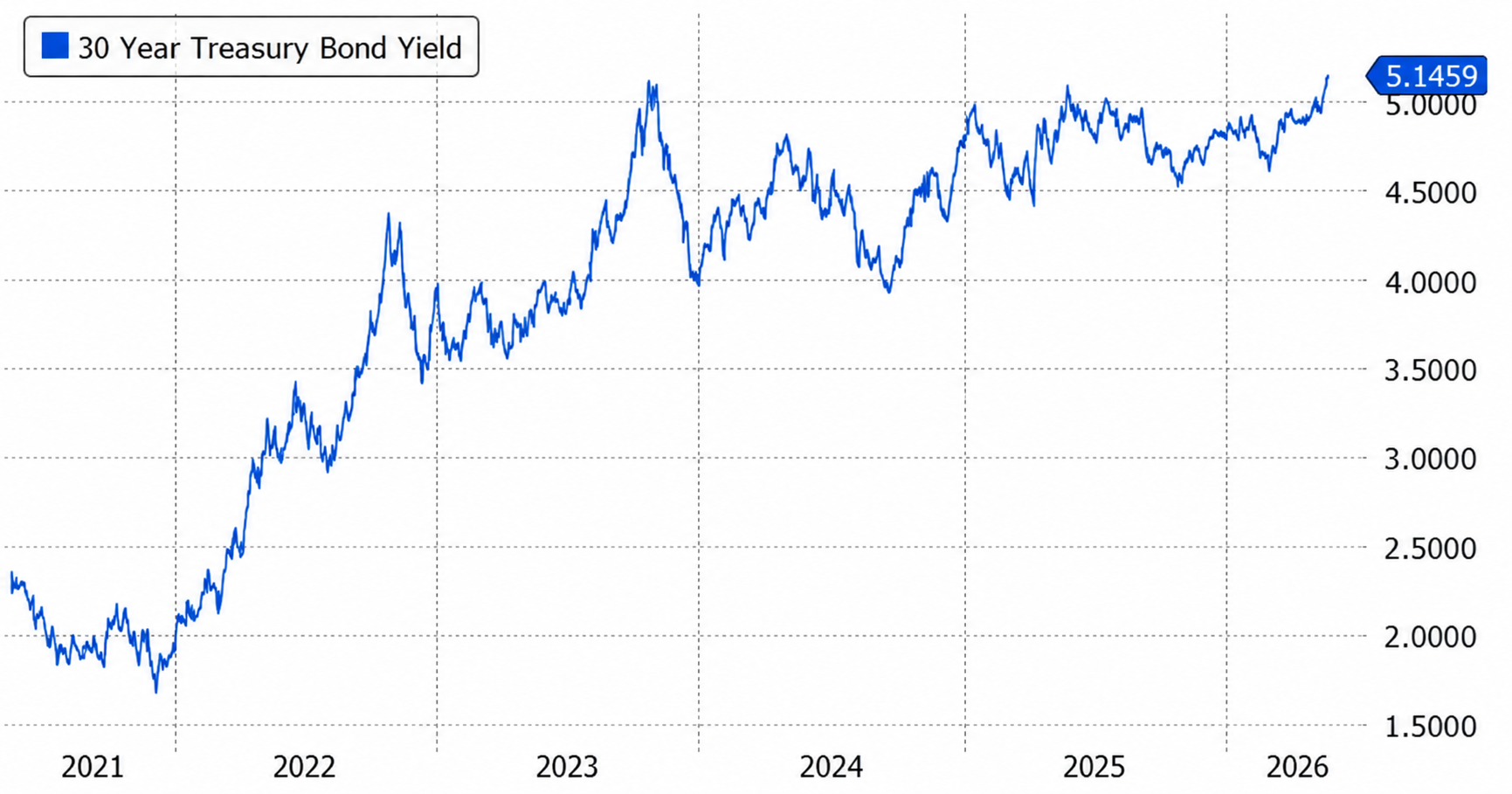
A relentless wave of fixed-income liquidation has sent long-dated borrowing costs spiraling to multi-decade peaks as the US 30-year yield hits highest since 2004 levels at 5.44%. The four-basis-point surge on Thursday marked the latest milestone in an extended sovereign bond rout driven by mounting fiscal deficits, stubborn inflation, and a fresh rally in global crude oil prices. With sovereign benchmark yields across shorter and intermediate maturities hovering near highs not seen since 2007, fixed-income markets are undergoing a fundamental repricing of long-term term premia.
The rapid repricing across sovereign debt markets carries significant consequences for residential real estate financing, municipal bond issuances, and corporate debt service costs. When long-term sovereign rates rise, the cost of long-term capital increases across the board, pressuring asset valuations and tightening corporate liquidity. For institutional asset allocators, credit analysts, and fixed-income portfolio managers monitoring how shifts in sovereign curves alter debt capital distribution, comprehensive analysis across markets provides indispensable clarity on modern fixed-income volatility.
The 5.44% Breakthrough: Oil Pressures and the Term Premia Revolt
The primary catalyst pushing the benchmark to this two-decade record is a toxic combination of energy price shocks and heavy sovereign debt issuance. Following a sharp jump in Brent crude oil futures, inflation expectations across Wall Street desks ratcheted higher, driving investors out of long-dated paper.
As the US 30-year yield hits highest since 2004 mark, bondholders are demanding significantly higher yields to offset long-term holding risks. “People are running out of superlatives for the yield on the 30-year bond,” remarked Ed Al-Hussainy, senior portfolio manager at Columbia Threadneedle. “Investors are saying, ‘Look, if we’re going to lock up our money for 30 years, we need much higher compensation.'”
Structural Drivers Behind the Yield Curve Shift
The persistent bond market selloff is anchored in three compounding dynamics:
- Oil-Driven Inflationary Pressures: Elevated energy benchmarks continue to feed into headline price indices, limiting the Federal Reserve’s room for monetary easing.
- Ballooning Debt Supply: Relentless US Treasury coupon auctions are testing primary dealer balance sheets, forcing yields upward to clear hundreds of billions in fresh federal issuance.
- Macro Resilience: Resilient domestic economic growth figures have dismantled early expectations of emergency interest rate cuts, forcing market participants to price in higher terminal policy rates for longer.
Persistent fiscal expansion and sovereign deficit spending directly influence domestic currency valuations, consumer borrowing terms, and macroeconomic stability. Economists tracking how structural deficit financing and long-term interest rates shape national economic output can evaluate cyclical developments through dedicated reporting on the wider economy.
Treasury Department Interventions: Why Buybacks Have Failed
The fact that the US 30-year yield hits highest since 2004 milestone underscores the limitations of unilateral fiscal intervention. In an attempt to ease secondary market liquidity friction and bring down long-term borrowing costs, Treasury Secretary Scott Bessent expanded the federal government’s bond buyback program in mid-August.
However, the Treasury’s liquidity operations have had minimal lasting impact against global macro trends. Market participants have absorbed the buyback liquidity while continuing to demand higher risk premiums, recognizing that treasury buybacks cannot offset the sheer volume of net-new debt required to finance annual federal budget deficits.
Federal spending policy, statutory debt limit debates, and executive tariff agendas remain deeply politicized ahead of national legislative elections. Observers analyzing how executive branch appointments and congressional budget battles govern sovereign debt issuance can examine political developments via politics.
Algorithmic Yield Optimization, Financial Tech, and Treasury Reserves
The historic volatility that unfolded as the US 30-year yield hits highest since 2004 is driving major shifts in institutional asset management. Quantitative debt funds and primary dealers are utilizing machine-learning interest rate models, real-time liquidity aggregators, and automated order-execution algorithms to manage duration risk across multi-billion-dollar bond portfolios. Technology professionals tracking quantitative finance platforms and high-frequency trading infrastructure follow software innovations through specialized coverage of tech.
At the same time, institutional treasuries navigating declining long-bond asset values are exploring alternative, non-sovereign reserve structures. With traditional paper debt suffering capital losses, corporate treasurers are evaluating programmatic settlement protocols, tokenized real-world assets (RWAs), and crypto networks to preserve balance-sheet purchasing power and hedge against fiat debt debasement.
Valuation Pressures Across Rate-Sensitive Equities
The equity market reaction to the benchmark shift has been swift, as the reality that the US 30-year yield hits highest since 2004 level ripples across capital structures. Elevated risk-free discount rates directly compress equity valuation multiples, creating sharp headwinds for dividend-heavy utilities, commercial real estate investment trusts (REITs), and capital-intensive infrastructure firms. Equity research analysts continuously monitor these discount rate adjustments and corporate interest coverage ratios across publicly traded stocks.
According to formal market tracking from the Federal Reserve Bank of New York, maintaining functional secondary liquidity in benchmark Treasury securities remains essential to ensuring credit flow across the real economy.
As long as oil prices remain elevated and federal budget deficits expand, long-dated sovereign debt will remain under pressure. With the US 30-year yield hits highest since 2004 benchmark setting a new floor for long-term borrowing costs, global financial markets must adjust to an era of structurally higher capital costs that will test consumers, corporations, and governments alike.
Disclaimer:
The information provided in this article is for educational, journalistic, and informational purposes only and does not constitute financial, investment, legal, or fixed-income trading advice.