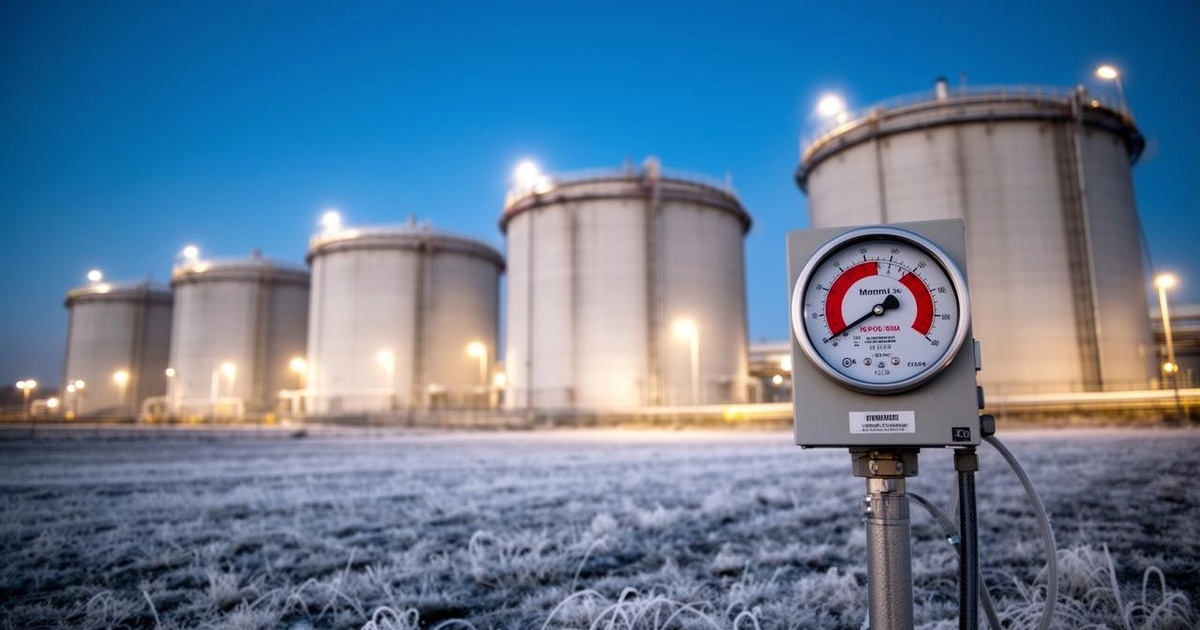
The alarming depletion of European natural gas storage reserves has placed the continent on the precipice of its most severe supply shortfall in nearly two decades. Addressing industry delegates at the Gastech energy conference in Bangkok, energy market analysts and consultancy leaders revealed that continental inventories are tracking between 65% and 69% of aggregate capacity. With approximately 20% of the world’s liquefied natural gas (LNG) supply offline following Middle East conflict disruptions in the Strait of Hormuz and extensive structural damage to Qatari export facilities, the deficit in European natural gas storage leaves regional economies without an operational safety buffer heading into winter.
The emergence of a structural gas deficit introduces severe operational uncertainty for heavy industrial manufacturers, base-load electric utilities, and sovereign fiscal planners. When seasonal inventory buffers contract ahead of peak winter demand, commercial supply chains face immediate rationing risks and sharp inflationary pressures. For corporate treasurers, institutional portfolio managers, and energy analysts monitoring how critical commodity volatility shapes monetary and fiscal policy, continuous reporting on the broader economy provides vital context on continental resilience.
Why European Natural Gas Storage Sits at Decades-Low Benchmarks
The current volume in European natural gas storage facilities deviates sharply from historical replenishment cycles. Data published by Rystad Energy projects the continent’s aggregate storage at approximately 67% full far below the five-year seasonal baseline of 84%. Wood Mackenzie’s historical tracking reveals that European gas inventories have reached their lowest levels for this calendar stage since 2009.
Regional Vulnerabilities: Germany and the United Kingdom
The inventory shortfall is heavily concentrated across Europe’s leading industrial powerhouses:
- German Exposure: Storage across Germany sits at approximately 55% of capacity, leaving Europe’s largest manufacturing economy critically exposed to supply curtailments.
- State Utility Intervention: German state-owned energy entity SEFE which controls one-quarter of national storage volume is operating under emergency mandates to accelerate inventory injections.
- The UK Buffering Deficit: The United Kingdom faces acute vulnerability due to minimal domestic storage infrastructure, relying almost entirely on real-time LNG offloading and interconnectors from continental Europe.
- Industrial Shutdown Warnings: Sir Jim Ratcliffe, founder of petrochemical multinational Ineos, warned that a sharp cold snap could force industrial facilities offline to safeguard residential heating.
David Lewis, principal European gas and LNG analyst at Wood Mackenzie, cautioned that with inventories at historic lows and market balances unlikely to normalize before 2028, any cold snap will translate directly into immediate price shocks.
As commodity deficits challenge industrial output, changing production costs ripple across sovereign debt and equities in international markets.
The Global Arbitrage: Asian Bidding Wars and North Sea Policy
A major complicating factor undermining European natural gas storage is intense competition from Asian buyers. S&P Global Energy assessments indicate that spot LNG prices across high-growth Asian markets have risen to $30 per million British thermal units (mmBtu), up from pre-conflict baselines of roughly $10 per mmBtu. Analysts project that an unseasonably cold winter could ignite aggressive transatlantic bidding wars, propelling spot prices into the $40 to $45 per mmBtu range.
This inter-basin arbitrage threatens to divert flexible Atlantic LNG cargoes toward Asian terminals precisely when European utilities require prompt deliveries. In Britain, energy security concerns are heightened by domestic political decisions. The UK government’s 2024 moratorium on new North Sea exploration licenses has limited domestic extraction from a basin that neighboring Norway continues to tap for export.
Government reserve mandates, emergency industrial rationing protocols, and diplomatic energy pacts remain central to legislative debates. Observers tracking how executive policies and ministerial regulations govern utility allocations can monitor updates via politics.
Energy Automation, Microgrids, and Digital Liquidity Reserves
Managing the strain on European natural gas storage necessitates advanced industrial energy technology. Heavy manufacturing enterprises are deploying automated load-shedding algorithms, predictive IoT fuel management systems, and high-efficiency heat exchangers to reduce gas consumption. Technology professionals tracking industrial automation and thermal management systems follow updates through specialized coverage of tech.
Simultaneously, multinational manufacturers exposed to extreme fuel volatility are overhauling treasury risk strategies. As working capital requirements expand alongside wholesale energy costs, corporate treasuries evaluate decentralized finance protocols and crypto rails to execute real-time cross-border settlements and hedge against currency volatility during geopolitical disruptions.
Corporate Exposure Across Chemical and Utility Equities
The contraction in European natural gas storage carries direct financial consequences for publicly traded corporations. Energy-intensive sectors—including specialty chemicals, fertilizer producers, glass manufacturers, and steel mills—face margin compression or temporary plant idling if wholesale gas prices spike. Equity research analysts continuously monitor these production margins and operating cash flows across European industrial and utility stocks.
According to formal industry tracking from Gas Infrastructure Europe (GIE), reaching the revised 80% winter storage target remains mathematically improbable without unseasonably warm weather and uninterrupted cargo arrivals. Energy executives from Equinor and Shell noted at Gastech that while regional storage might attain 75% capacity by early November, full replenishment targets will remain out of reach.
Without a swift resolution to maritime disruptions in the Middle East, the reality of European natural gas storage guarantees a volatile winter. European industries enter the heating season with virtually no operational margin for error, where weather conditions will dictate whether factories remain powered or face emergency curtailments.
Disclaimer:
The information provided in this article is for educational, journalistic, and informational purposes only and does not constitute financial, investment, energy trading, or legal advice.